Harmonic Exciters and Saturation in Mastering
Adding Character and Warmth
Harmonic Exciters and Saturation in Mastering introduce subtle harmonic overtones that enhance clarity, warmth, and perceived loudness without heavy compression. These tools emulate the behavior of analog circuits, adding pleasing coloration and depth. Harmonic Exciters and Saturation in Mastering help make sterile digital mixes feel fuller and more engaging by emphasizing harmonics that our ears naturally interpret as richness and energy. When applied tastefully, they add cohesion and brightness while maintaining the integrity of the original mix.
The Science of Harmonics
Sound waves contain harmonics — multiples of a fundamental frequency that define timbre. Harmonic Exciters and Saturation in Mastering work by generating these harmonics intentionally. Even-order harmonics (2nd, 4th, etc.) create warmth and smoothness, while odd-order harmonics (3rd, 5th, etc.) introduce edge and presence. Tube and tape emulations often emphasize even harmonics, resulting in a gentle, musical enhancement. Transistor or digital saturation adds more bite and brightness. Mastering engineers blend these textures to add subtle excitement and dimension without altering the tonal balance drastically.
Exciters vs. Saturation
While often grouped together, exciters and saturation units serve slightly different purposes. In Harmonic Exciters and Saturation in Mastering, exciters focus on adding clarity and shimmer, typically in the upper mids and highs. They generate harmonics through controlled distortion and filtering, enhancing brightness without harsh EQ boosts. Saturation, on the other hand, affects the entire spectrum, compressing transients and adding low-end thickness. Used together, these tools enrich the sonic texture — exciters for brilliance and detail, saturation for body and cohesion.
Applying Harmonic Processing in the Chain
Placement within the mastering chain greatly affects results. Harmonic Exciters and Saturation in Mastering often appear after corrective EQ and compression but before final limiting. This ensures a balanced tonal foundation while allowing the harmonic character to shape perceived loudness. Overuse can quickly lead to distortion or loss of clarity, so subtlety is key — often less than 10% mix or 1–2 dB of harmonic enhancement is sufficient. Monitoring through multiple playback systems helps verify that the added color translates consistently across environments.
Analog vs. Digital Approaches
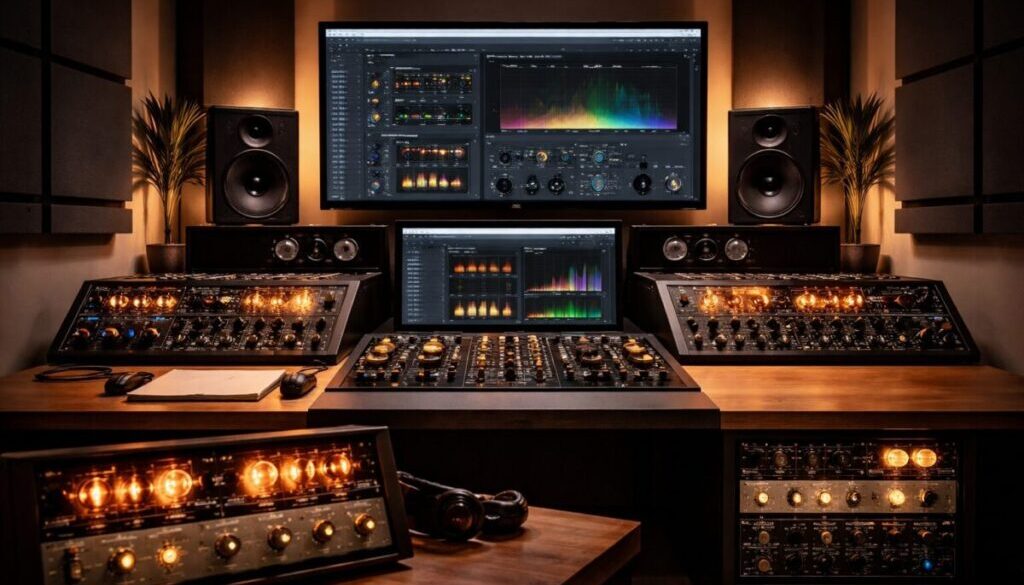
Analog gear such as tape machines, tube compressors, and transformer-based EQs naturally introduce pleasing saturation. In digital workflows, Harmonic Exciters and Saturation in Mastering rely on high-quality plugins that emulate these behaviors. Modern digital processors allow precise control over harmonic type, drive intensity, and frequency focus. Combining both worlds in a hybrid setup delivers the best of each: analog warmth and digital precision. Regardless of medium, harmonic enhancement should always complement the mix, not disguise it.
Maintaining Clarity and Dynamics
The ultimate goal of Harmonic Exciters and Saturation in Mastering is to enhance depth and perceived loudness without sacrificing openness. A well-tuned harmonic layer can replace excessive EQ boosts, improving presence without frequency imbalance. Overdriving, however, risks masking transients and muddying low-end detail. Always A/B test with bypassed processing to confirm that excitement and warmth feel natural. When used with finesse, harmonic exciters and saturation bring music to life — turning a technically correct mix into a master that feels emotionally and sonically complete.